Final project for BIO477Saareya Sahlool

Forest Gap Models& Climate Resilience

An interactive modeling site for how forests are affected by climate change using gap dynamics.

Introduction

Forests are not as static as some people are lead to believe. Rather, they are dynamic systems that are ever-changing. Trees grow, compete for resources such as sunlight, and eventually die, which creates openings in the forest canopy that are called gaps. These gaps are the primary drivers of forest regeneration because they allow new seedlings to establish and grow in the freshly available sunlight.

"The window of regeneration after a disturbance is thus a pivotal time in the context of forest resilience." (Rammer et al., 2021)

As a reader, understanding how these canopy gaps form, how they are filled, and how these processes might change when under climate stress is extremely important for predicting forest resilience. This is where forest gap models come into play, which are computational tools that simulate these gap dynamics at varying scales (individual trees all the way to entire landscapes).

31%

of Earth's land surface covered by forests

2.6B

tonnes of CO₂ absorbed annually by forests

80%

of terrestrial biodiversity lives in forests

In this interactive website, one can understand the science behind forest gap dynamics by diving into the mathematical models that ecologists use to simulate changes in forests and look at real-world studies showing how various models help understand forest resilience.

Forests in a Changing Climate

Over the past few decades, most forests have been impacted from warmer temperatures, extended wildfire seasons and increased frequency of droughts. These impacts create changes to the occurrence of disturbances (such as fires) and the amount of time available between disturbances, while also pushing trees further toward the limits of what can be tolerated by their environment.

In ecological studies, ecologists will use the term "resilience" to explain how an ecosystem responds to disturbances (or stresses). Forests that are resilient can resist disturbances (many trees survive through a drought), or if they are disturbed, they can rebound with the next generation of trees. However, once disturbances occur so frequently, or become so severe, or if disturbances begin occurring under more stressful environmental conditions. Then, the forest will no longer be able to produce the next generation of trees and will eventually convert to an alternate state such as shrublands or grasslands.

For example, recent wildfires in the Rocky Mountains have had reduced conifer regeneration compared to the end of the twentieth century in some areas, particularly where the climate is warming and drying at the edge of species ranges. In fact, in some areas, seedlings were unable to grow and were therefore unable to establish themselves. This suggests that forests are already beyond the threshold of resilience under present environmental conditions. This project will use forest gap and landscape modeling techniques to determine when forests can still recover from disturbances and when they will exceed thresholds of resilience.

Warming temperatures

The warmer spring/summer growing seasons will cause many species to grow beyond their thermal maxima for growth, thus reducing their ability to recover from disturbance.

Drier conditions

Due to changes in precipitation and increasing evaporation rates, drier conditions will be established, thus increasing moisture stress and lowering post-fire seedling survival.

Shifting forest states

Over time if repeated regeneration attempts fail, in some cases closed forests will transition into a more open shrub/grass dominated landscape.

How Forest Gap Models Think

Forest gap models divide up the forest into several areas with approximately as much area as a few tree crowns. Within those patches, it simulates growth of trees or small groups (cohorts) and competition among them for light. Trees are simulated growing, competing for light, dying and new seedlings can be established in gaps created by dead trees at each simulation time step.

The forest gap model is run repeatedly over many decades across multiple hundred to thousands of patches, which allows the model to simulate forest succession and the effects of changes in climate on forest ecosystems. Gap models can also examine how disturbances such as fires affect the growth and regeneration of forest when combined with other disturbance models or run at larger scales than single stands of forest.

Core processes in a gap model

Growth

Trees grow in diameter and height every year based on species traits, light availability, and climate.

Competition

Larger trees shade smaller trees, and neighboring trees compete for light as well as other resources in every patch.

Mortality

Trees can either die from age, a lack of growth over many years, or through a disturbance event such as fire.

Regeneration

New seedlings establish in openings if the conditions fall within a species’ tolerance and there are seed sources.

From stand models to landscape applications

Early gap models were made to apply for single stands, however, a growing number of modern applications have employed a landscape scale framework in which thousands of patches are simulated, and specifically identify both where and when disturbances (such as fires) will take place. Landscape gap models are particularly used for understanding resilience questions because they relate local regeneration processes to larger-scale patterns like hotspots of regeneration failure.

JABOWA

1972

Botkin et al.

A pioneer forest gap model which simulated individual tree growth, death, and regeneration on small plots in northeastern US forests.

Individual-basedAnnual time stepLight competition

FORET

1977

Shugart & West

Built upon the gap-model approach to additional forest types with refined species parameters and environment responses.

Expanded species setEnvironmental response functionsMortality formulations

SORTIE

1993

Pacala et al.

Tracked individual tree positions (spatially explicit) and neighborhood interactions, like seed dispersal.

Spatially explicitNeighborhood competitionSeed dispersal

FORMIND

1998

Huth & Ditzer

A cohort-based gap model which was developed for tropical forests and then later adapted to other regions.

Cohort-basedFlexible architectureMultiple forest types

A gap model loop

What happens in one patch, repeated many times.

Light environment
Canopy shading sets who gets enough light to grow.
Growth update
Trees increment in size based on traits and climate conditions.
Mortality / disturbance
Trees die from age, stress, low growth, or events like fire.
Regeneration
Seedlings establish if there are seed sources and conditions allow.
Repeat
Run the same loop for decades across hundreds to thousands of patches.

This is the basic engine for gap models. The simple rules at the patch level can be scaled up

Equation Lab

Water deficit is one of the climate variables that is used to explain regeneration outcomes after a fire in the Rocky Mountains, as seen in Stevens-Rumann et al. (2017).

The equation is written as AET - PET (in mm).

The equation

WD = AETPET

Where WD is water deficit (mm), AET is actual evapotranspiration, and PET is potential evapotranspiration.

650 mm

Higher AET usually reflects more water actually used by the system.

950 mm

Higher PET means higher atmospheric “demand” for water.

Calculated value

-300 mm
WD = AET − PET
High moisture stress
Read it: With AET = 650 and PET = 950, water deficit is -300 mm.

Interactive graph

PET (mm)WD (mm)08001600

Another equation

Turner et al. (2019) show a relationship in Figure 4 of their paper between remaining postfire cones and lodgepole pine seedling density:

y = 0.0018x + 3.0475

Where x is remaining postfire cones (cones ha−1) and y is the response shown in Fig. 4 for lodgepole pine seedlings (stems ha−1). (“ha−1” means “per hectare.”)

This kind of equation is useful because it displays the pattern in the data with a slope (how strongly seedlings increase as cones increase) and an intercept (the predicted baseline when cones are near zero).

300

Slide to see what the fitted line predicts at different cone densities.

Predicted value from the line
3.587
y = 0.0018x + 3.0475
3,868
[Inference] If y is log10(scale), then seedlings ≈ 10^y (stems ha−1)
Read it: With x = 300 cones ha−1, the line gives y = 3.587.
x: cones ha−1y03006003.04.0

Case Studies & Future Scenarios

The studies below connect model structure, empirical trends, and landscape-scale projections. Together they show how regeneration processes control resilience today and how they might shape the future of fire-prone forests.

Rocky Mountain post-fire regeneration

US Rocky Mountains

Key question

Are recent wildfires followed by the same level of tree regeneration as in the late 20th century?

  • Across 1485 sites burned in 52 wildfires, post-fire conifer seedling densities were often lower in 2000–2015 than in 1985–1999.
  • Sites at the warm, dry edge of species' ranges showed the highest probability of regeneration failure.
  • Warmer, drier post-fire conditions are already pushing some forests beyond their historical resilience.
Management implication: Monitoring and modeling need to focus on warm, dry margins of species' ranges, where conversion to non-forest is most likely.
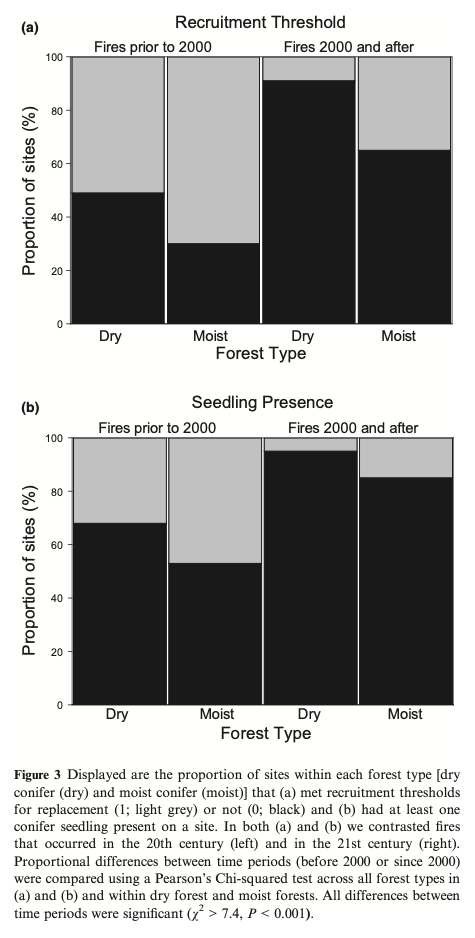
Stevens-Rumann et al. (2017) Figure 3
Stevens-Rumann et al. (2017) – Figure 3
Open figure
Short-interval fire in lodgepole pine

Greater Yellowstone, USA

Key question

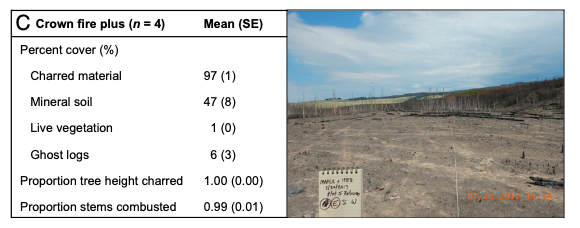
What happens when severe fire returns to lodgepole pine forests before they have fully recovered?

  • Short-interval reburns can reach "crown fire plus" severity, consuming nearly all aboveground biomass.
  • Post-fire seedling densities were reduced by about a factor of six compared to long-interval fires.
  • Simulations suggest that aboveground carbon recovery can be delayed by more than 150 years.
Management implication: Even fire-adapted forests can lose resilience if intervals between severe fires become too short for trees to reach reproductive age.
Turner et al. (2019) Figure 1c (crown fire plus)
Turner et al. (2019) – Figure 1c
Open figure

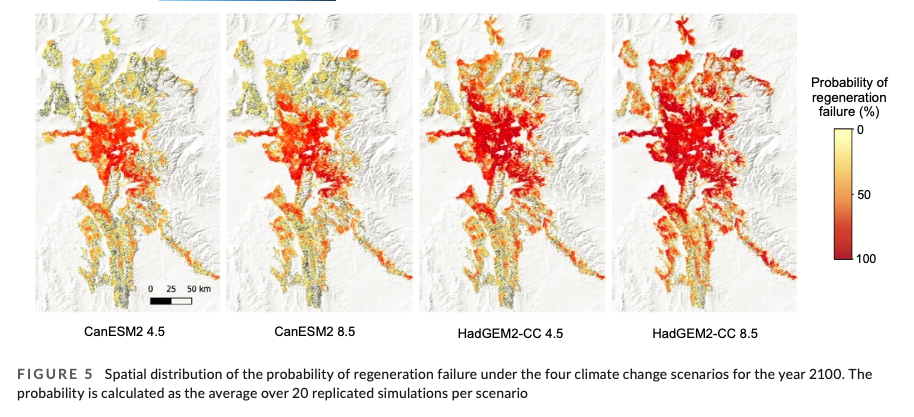
Future regeneration failure in Greater Yellowstone

Greater Yellowstone Ecosystem

Key question

How widespread might regeneration failure become under future climate and fire regimes?

  • Simulations combining vegetation models and data-driven fire projections show strong increases in both burned area and unstocked forest area by 2100.
  • Between 28% and 59% of currently forested area is projected to fail to regenerate above 50 stems per hectare under studied scenarios.
  • High-elevation, poorly fire-adapted forest types are especially vulnerable, and spatial hotspots of risk emerge.
Management implication: Gap and landscape models can help identify hotspots where management may need to support regeneration or plan for long-term ecosystem change.
Rammer et al. (2021) Figure 5 (probability of regeneration failure)
Rammer et al. (2021) – Figure 5
Open figure

Fire interval and lodgepole pine resilience

Move the slider to see a conceptual mechanism: shorter intervals reduce the cone bank (seed source) and regeneration potential. Conceptual, based on Turner et al. (2019).

Long interval
Fire interval70
Cone bank indicator
Longer intervals allow more cones/seeds to accumulate before the next fire.
High
Seedling density indicator
A simple proxy for regeneration potential as seed source increases.
Medium
Stand density sketch
More dots = denser post-fire regeneration (conceptual).
Moderate
Trees have time to reach maturity and build a cone bank. Regeneration potential is generally higher.

Concept Map

This concept map shows how the core papers in the project connect. Click any node to highlight its role in the network of models, empirical evidence, and future projections.

defines processes inframes resilience questions forshows observed limits ofillustrates a mechanism affectingprojects futures forinforms model capabilityscales up to hotspotsModel structure & processesResilience modelingForest resilience & gap modelsEmpirical regeneration dataShort-interval fire impactsLandscape futures & hotspots

Forest resilience & gap models

Central theme of the project: using gap and landscape gap models to connect mechanisms (growth, mortality, regeneration) to resilience outcomes under climate change and changing fire regimes.

Core paper(s)
  • Bugmann & Seidl (2022)
  • Albrich et al. (2020)
  • Stevens-Rumann et al. (2017)
  • Turner et al. (2019)
  • Rammer et al. (2021)

The upper nodes summarize how model structure and resilience modeling papers define what current gap and landscape models can represent. Lower nodes show how empirical regeneration data and short-interval fire studies reveal emerging limits to resilience.

The landscape futures node ties these strands together, using models informed by structure and evidence to project where regeneration failure may become widespread. This map mirrors the funnel structure of the project: from broad model capabilities to specific mechanisms and finally to large-scale projections.

References

Bugmann, H., & Seidl, R. (2022). The evolution, complexity and diversity of models of long-term forest dynamics. Journal of Ecology, 110(7), 2288–2307. DOI

Model evolution

Albrich, K., Rammer, W., Turner, M. G., Ratajczak, Z., Braziunas, K. H., Hansen, W. D., & Seidl, R. (2020). Simulating forest resilience: A review. Global Ecology and Biogeography, 29(12), 2082–2096. DOI

Resilience review

Stevens-Rumann, C. S., Kemp, K. B., Higuera, P. E., Harvey, B. J., Rother, M. T., Donato, D. C., Morgan, P., & Veblen, T. T. (2018). Evidence for declining forest resilience to wildfires under climate change. Ecology Letters, 21(2), 243–252. DOI

Empirical regeneration

Turner, M. G., Braziunas, K. H., Hansen, W. D., & Harvey, B. J. (2019). Short-interval severe fire erodes the resilience of subalpine lodgepole pine forests. Proceedings of the National Academy of Sciences, 116(23), 11319–11328. DOI

Short-interval fire

Rammer, W., Braziunas, K. H., Hansen, W. D., Ratajczak, Z., Westerling, A. L., Turner, M. G., & Seidl, R. (2021). Widespread regeneration failure in forests of Greater Yellowstone under scenarios of future climate and wildfire. Global Change Biology, 27(18), 4339–4351. DOI

Landscape futures